

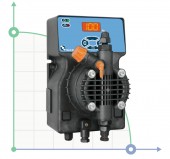
Solenoid pumps DLX (B)

Specifications
- Solenoid diaphragm metering pumps with analog microprocessor control;
- Metering pumps manufactured in accordance with CE regulations;
- Protection class: IP65;
- Anti-acid plastic housing, the control panel is protected by a film from UV radiation;
- Modern dosing pump technology with integrated pH, RedOx, Cl, CD controllers in a compact execution;
- HRS Extended Dosing Pumps;
- Supports level sensors, flow sensors, output flow sensors;
- Leading plant series: DLX - wall mount, DLXB - horizontal mount;
- DLX (B) pumps have a wide range of applications: water treatment, water treatment, waste water treatment, disinfection of water in swimming pools and water parks, agriculture, chemical, paint and varnish, textile, food industry, production of beer, drinks, etc.;
- From 01/07/2010 the standard equipment of the pumps is a PVDF head with double ball valves;
- Advanced technology;
- The best ratio in terms of the indicator: PRICE /QUALITY.
Application of diaphragm metering pumps
Chemical and food industry, breweries, production of alcoholic and non-alcoholic beverages, drinking water preparation, waste water treatment, water disinfection, water preparation for boilers, etc.
External dimensions
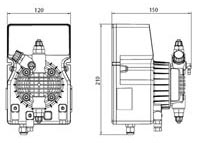
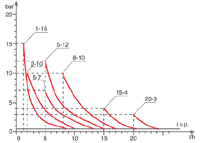
| A type pump |
Max. flow | Volume momentum |
Stroke length piston |
Consumed power |
The weight net |
||
| l/hour | bar | ml | mm | W | AND | kg | |
| 01-15 | 1 | 15 | 0,14 | 0,80 | 37 | 0,16 | 2,30 |
| 02-10 | 2 | 10 | 0,28 | 0,80 | 37 | 0,16 | 2,30 |
| 05-07 | 5 | 7 | 0,69 | 1,00 | 37 | 0,16 | 2,30 |
| 05-12 | 5 | 12 | 0,69 | 1,00 | 58 | 0,25 | 2,90 |
| 08-10 | 8 | 10 | 1,11 | 1,40 | 58 | 0,25 | 2,90 |
| 15-04 | 15 | 4 | 2,08 | 2,20 | 58 | 0,25 | 2,90 |
| 20-03 | 20 | 3 | 2,78 | 2,20 | 58 | 0,25 | 2,90 |
Notes
- In standard ON /OFF dosing mode 100 imp /min only for models DLX-MA /M 02-10; 05-07 and 05-12, for everyone
other models: 120 imp /min; HRS system operates in the range of 100 /120-240 imp /min, according to the actual
set back pressure; standard reagent intake height: 2 m; standard voltage: 230 V ±
10% 50 Hz; the capacity of the metering pumps is determined when testing the pumps with water with medium hardness,
at nominal pressure, lifting height 1.5 m, at room temperature.
MODEL CONFIGURATIONS
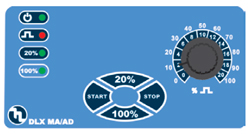
MA /AD
- Analog Diaphragm Pump Dispenser;
- Continuous ON / OFF dosing mode;
- Dual scale performance adjustment: 10-100% and 0-20%;
- Two status indicators;
- Start /stop button;
- Without level sensor support.
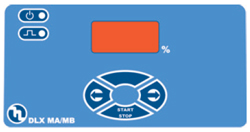
MA /MB
- Microprocessor controlled diaphragm dosing pump;
- 3-digit display;
- Continuous ON / OFF dosing mode;
- Manual performance adjustment: 0-100%;
- Three status display indicators;
- Start /stop button;
- Level sensor support (sensor not included).
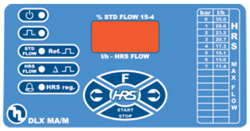
MA /M
- Microprocessor controlled diaphragm dosing pump;
- 3-digit display;
- Manual performance adjustment: 0-100%;
- Start /stop button;
- Dosing mode: continuous ON /OFF and HRS extended;
- Electronic interface HRS for changing max. pump capacity (in l/h) in accordance with back pressure in the system;
- Support for output flow sensors, level (sensors are not included in the package).
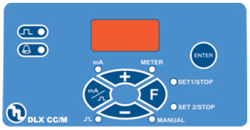
CC / M
- Dosing pump proportional dosing from an external mA signal;
- Dosing modes: constant ON /OFF and proportional from an external signal (0) 4-20 mA;
- Supports forward and reverse mode (4-20 or 20-4 mA);
- Level sensor support (sensor not included).
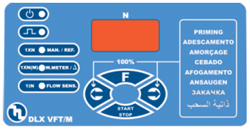
VFT /M
- Proportional dosing pump powered by impulse flow meter;
- Dosing modes: ON /OFF and PROP .: 1xN multiplication, 1xN multiplication (M), 1: N division;
- Support for output flow sensors, level (sensors are not included in the package).
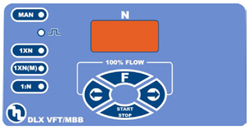
VFT /MBB
- Proportional dosing pump powered by impulse flow meter;
- Microprocessor control;
- Simplified user menu and settings;
- Dosing modes: ON /OFF and PROP .: 1xN multiplication, 1xN multiplication (M), 1: N division;
- Level sensor support (sensor not included).
MF /M
- Multifunctional digital proportional dosing pump with microprocessor;
- Dosing modes: continuous ON /OFF, PROP .: 4-20 mA, from a pulse flow meter: 1xN multiplication, multiplication with memory 1xN (M), division 1: N; by the set number of ppm, by the timer
- Electronic clock, timer, buzzer;
- 4-20 mA output;
- Alarm ON /OFF output;
- Support for output flow sensors, level (sensors are not included in the package).

PH-RX /MBB
- Proportional dosing pump with built-in pH /RedOx controller (optional);
- Measurement range: 0-14 pH; -1000 +1400 mV;
- Simplified user menu;
- Delayed pump start;
- Support for flow sensors, level (sensors are not included in the package).

PH-RX-CL /MBB
- Proportional dosing pump with built-in pH /RedOx /Cl controller (optional);
- Measurement range: 0-14 pH; -1000 +1400 mV: 0-20 ppm;
- Menu selection: Basic /Full;
- Settings password;
- Continuous dosing time alarm;
- Delayed pump start;
- Support for flow sensors, level (sensors are not included in the package).
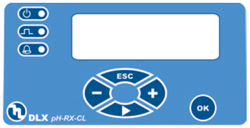
PH-RX-CL/M /
- Proportional dosing pump with built-in pH /RedOx /Cl controller (optional);
- Measurement range: 0-14 pH; -1000 +1400 mV: 0-20 ppm;
- Menu selection: Basic /Full;
- Alarm ON /OFF output;
- 4-20 mA output;
- Settings password;
- Automatic temperature compensation (when connecting a PT100 temperature sensor);
- Support for flow sensors, level, PT100 (sensors not included).

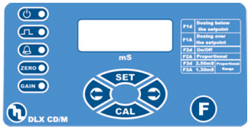
CD /M
- Diaphragm dosing pump with built-in CD (conductivity) controller;
- Measurement range: 0-1,000 mS (K5) or 0-10,000 mS (K1);
- 4-20 mA output;
- Dosing modes: constant ON /OFF and proportional;
- Persistent memory;
- Level sensor support (sensor not included).
Pump head materials
| Materials | Standard | On request |
| Metering pump head | Polypropylene | PVC; n /st AISI 316; Teflon; PVDF |
| Membrane | Teflon | --- |
| Diaphragm gasket | Viton® | Dyutral®; Nitrile |
| Injection valve | Polypropylene | n /st AISI 316; Teflon |
| Intake valve /filter | Polypropylene | n /st AISI 316; Teflon |
| Intake /Bleed Hose | Pvc | --- |
| Dump hose | Polyethylene | --- |
| Locking valves | Viton® | Dyutral®; Nitrile |
| Valve gaskets | Viton® | Dyutral®; Nitrile |
| Ball valves | --- | n /st AISI 316; borosilicate glass |
Accessories for a standard head 2-15 l/h metering pump
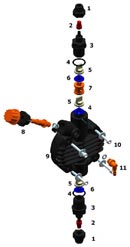
- Hose nut.
- Connection plug.
- Nipple.
- Gasket, O-ring.
- Locking valves (ball valves available on request).
- Valve seat.
- Air release jet.
- Air bleed screw nipple.
- Metering pump head.
- Pump head mounting bolts.
- Air bleed outlet nipple.
The principle of operation of metering pumps
The principle of operation of the metering pump is as follows: on the piston (plunger), which is driven by the influence of a constant electromagnetic field of the solenoid, a Teflon membrane is attached. When the piston moves forward (under the influence of an electromagnetic field), pressure arises on the pump head, while discharge of liquid through the relief valve.
After the end of the exposure to the electromagnetic field, the piston returns to initial position with the help of a spring, while liquid is automatically drawn through the intake valve. The principle of operation is very simple, while the pump does not require lubrication, which reduces the maintenance process to almost zero. The materials used for the manufacture of the pumps make it possible to dispense corrosive liquids.
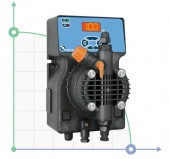
| Producer | ETATRON D.S. |
| Power supply | 1х220 V, 50 Hz |
| Control | Microprocessing |
| Power capacity, Wt | 37 W 0,16А |
| Model | MA/MB |
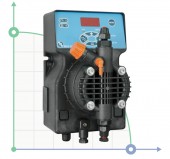
| Producer | ETATRON D.S. |
| Material | PP |
| Power supply | 1х220 V, 50 Hz |
| Control | Microprocessing |
| Power capacity, Wt | 37 W 0,16А |
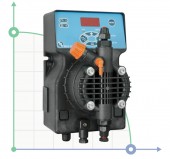
| Producer | ETATRON D.S. |
| Material | PP |
| Power supply | 1х220 V, 50 Hz |
| Control | Microprocessing |
| Power capacity, Wt | 58 |
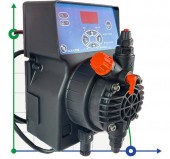
| Producer | ETATRON D.S. |
| Material | PP |
| Power supply | 1х220 V, 50 Hz |
| Control | Microprocessing |
| Power capacity, Wt | 37 W 0,16А |
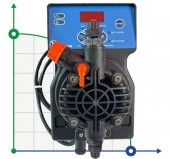
| Producer | ETATRON D.S. |
| Material | PP |
| Power supply | 1х220 V, 50 Hz |
| Control | Microprocessing |
| Power capacity, Wt | 58 |
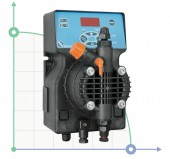
| Producer | ETATRON D.S. |
| Material | PP |
| Power supply | 1х220 V, 50 Hz |
| Control | Microprocessing |
| Power capacity, Wt | 58 |
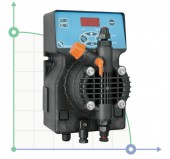
| Producer | ETATRON D.S. |
| Material | PP |
| Power supply | 1х220 V, 50 Hz |
| Control | Microprocessing |
| Power capacity, Wt | 58 |
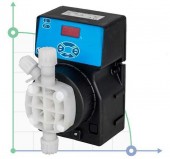
| Producer | ETATRON D.S. |
| Material | PVDF |
| Power supply | 1х220 V, 50 Hz |
| Control | Microprocessing |
| Power capacity, Wt | 37 W 0,16А |
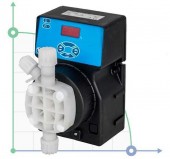
| Producer | ETATRON D.S. |
| Material | PVDF |
| Power supply | 1х220 V, 50 Hz |
| Control | Microprocessing |
| Power capacity, Wt | 37 W 0,16А |
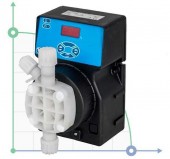
| Producer | ETATRON D.S. |
| Material | PVDF |
| Power supply | 1х220 V, 50 Hz |
| Control | Microprocessing |
| Power capacity, Wt | 58 |
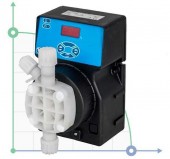
| Producer | ETATRON D.S. |
| Material | PP |
| Power supply | 1х220 V, 50 Hz |
| Control | Microprocessing |
| Power capacity, Wt | 58 |
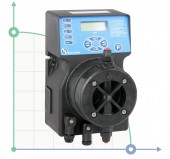
| Producer | ETATRON D.S. |
| Material | PP |
| Power supply | 1х220 V, 50 Hz |
| Control | Microprocessing |
| Power capacity, Wt | 37 W 0,16А |
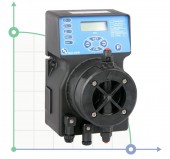
| Producer | ETATRON D.S. |
| Material | PP |
| Power supply | 1х220 V, 50 Hz |
| Control | Microprocessing |
| Power capacity, Wt | 58 |
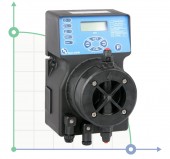
| Producer | ETATRON D.S. |
| Material | PP |
| Power supply | 1х220 V, 50 Hz |
| Control | Microprocessing |
| Power capacity, Wt | 37 W 0,16А |
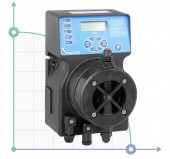
| Producer | ETATRON D.S. |
| Material | PP |
| Power supply | 1х220 V, 50 Hz |
| Control | Microprocessing |
| Power capacity, Wt | 58 |
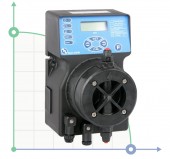
| Producer | ETATRON D.S. |
| Material | PP |
| Power supply | 1х220 V, 50 Hz |
| Control | Microprocessing |
| Power capacity, Wt | 58 |
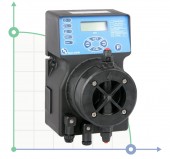
| Producer | ETATRON D.S. |
| Material | PP |
| Power supply | 1х220 V, 50 Hz |
| Control | Microprocessing |
| Power capacity, Wt | 58 |
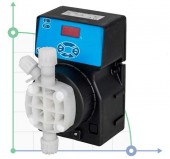
| Producer | ETATRON D.S. |
| Power capacity, kW | 8 |
| Material | PVDF |
| Power supply | 1х220 V, 50 Hz |
| Control | Microprocessing |
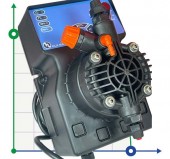
| Producer | ETATRON D.S. |
| Material | PP |
| Power supply | 1х220 V, 50 Hz |
| Control | Manual |
| Power capacity, Wt | 37 W 0,16А |
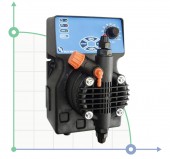
| Producer | ETATRON D.S. |
| Material | PP |
| Power supply | 1х220 V, 50 Hz |
| Control | Manual |
| Power capacity, Wt | 58 |
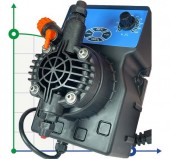
| Producer | ETATRON D.S. |
| Material | PP |
| Power supply | 1х220 V, 50 Hz |
| Control | Manual |
| Power capacity, Wt | 37 W 0,16А |
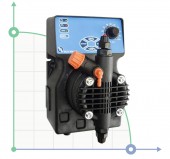
| Producer | ETATRON D.S. |
| Material | PP |
| Power supply | 1х220 V, 50 Hz |
| Control | Manual |
| Power capacity, Wt | 58 |
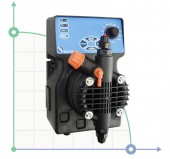
| Producer | ETATRON D.S. |
| Material | PP |
| Power supply | 1х220 V, 50 Hz |
| Control | Manual |
| Power capacity, Wt | 58 |
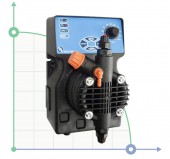
| Producer | ETATRON D.S. |
| Material | PP |
| Power supply | 1х220 V, 50 Hz |
| Control | Manual |
| Power capacity, Wt | 58 |
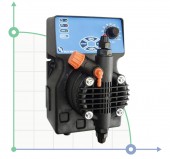
| Producer | ETATRON D.S. |
| Material | PP |
| Power supply | 24V |
| Control | Manual |
| Model | MA/AD |
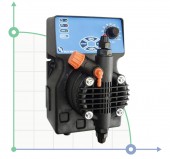
| Producer | ETATRON D.S. |
| Power capacity, kW | 10 |
| Power supply | 1х220 V, 50 Hz |
| Control | Manual |
| Power capacity, Wt | 58 |
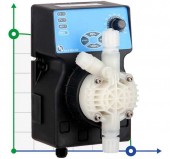
| Producer | ETATRON D.S. |
| Material | PVDF |
| Power supply | 1х220 V, 50 Hz |
| Control | Manual |
| Power capacity, Wt | 58 |
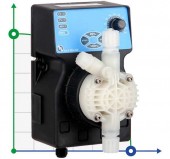
| Producer | ETATRON D.S. |
| Material | PVDF |
| Power supply | 1х220 V, 50 Hz |
| Control | Manual |
| Power capacity, Wt | 37 W 0,16А |
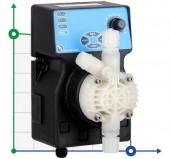
| Producer | ETATRON D.S. |
| Material | PVDF |
| Power supply | 1х220 V, 50 Hz |
| Control | Manual |
| Power capacity, Wt | 37 W 0,16А |
| Producer | ETATRON D.S. |
| Material | PP |
| Power supply | 1х220 V, 50 Hz |
| Control | Microprocessing |
| Power capacity, Wt | 58 |


